
View All Blog Posts
February 12, 2026



There is something clarifying about using your own product to build itself. At DevSwarm, parallel AI development is not a marketing concept or a roadmap aspiration: it is the daily workflow. The team builds DevSwarm with DevSwarm, and the experience of doing so has shaped the product in ways that no amount of user research could replicate.
A typical day starts with three or four builders running simultaneously, each assigned to a different feature or bug on its own isolated branch. One builder might be tackling a UI component, another refactoring a service layer, a third fixing a regression, and a fourth exploring an architectural change. Each operates in its own Git worktree, which means there is no risk of one agent's changes interfering with another's. The files, the branches, and the AI contexts are all completely independent.
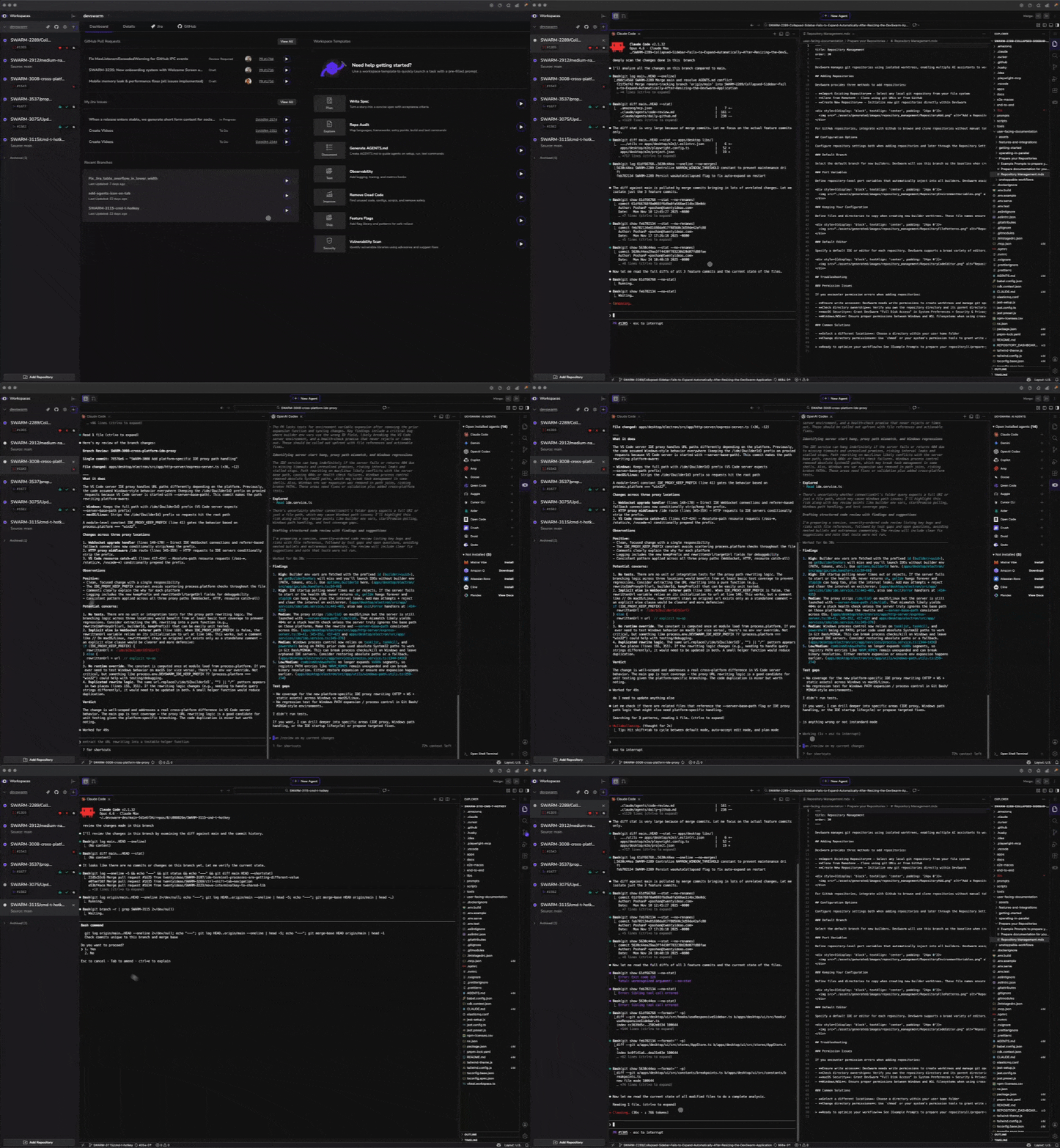
The record so far is eight builders running concurrently on non-trivial work. That is not eight minor typo fixes: it is eight real features and bugs progressing at the same time, each producing meaningful diffs that require genuine review. The keyboard shortcuts make this manageable rather than chaotic. Cmd+1 drops into the terminal to monitor an agent's progress, Cmd+3 opens the Git view to check a diff, and Cmd+N spins up a new builder when a fresh task surfaces. Switching between builders in the sidebar is instantaneous, so the developer can cycle through all active sessions in seconds.
Running multiple AI agents in parallel sounds like it could spiral into disorder, but DevSwarm's architecture is built specifically to prevent that. Each builder's Git worktree isolation ensures that agents never touch each other's files. The built-in Git status and diff views let you inspect exactly what each agent has changed without leaving the application. When a builder finishes, Review mode provides side-by-side code comparison so you can evaluate the output before anything gets merged.
This is where the developer's role becomes something genuinely different from traditional coding. The job is not to write code line by line, but to direct the work, monitor progress across multiple streams, and apply judgment about what ships and what gets rejected. It is orchestration in the truest sense: you are deciding what problems to solve in parallel, feeding each agent the context it needs, and reviewing the results as they arrive.
Seven months ago, the idea that a team could compress a month of work into days sounded like a wild exaggeration. AI coding assistants were useful, certainly, but the claim that they would fundamentally change the pace of development felt premature. That skepticism made sense at the time: single-agent workflows, where one AI handles one task while everything else waits, genuinely did not deliver transformative results.
What changed was not the AI models themselves, but the workflow around them. When you move from running one agent at a time to running four, five, or eight in parallel, the math shifts. The bottleneck is no longer how fast a single agent can generate code: it is how quickly you can define tasks, distribute them, and review the output. DevSwarm was designed around exactly this constraint, providing the isolation, the visibility, and the keyboard-driven speed to keep a developer effective across many concurrent sessions.
The features that enable this workflow are not individually revolutionary, but together they create something that was not previously achievable. Git worktree isolation keeps every builder's work cleanly separated. The mode system: Build, Explore, Git Actions, and Review: provides focused views for each phase of the development cycle without requiring external tools. The terminal integration means you can watch AI agents work in real time and intervene when needed. The unified sidebar gives an at-a-glance view of every active builder and its current state.
Perhaps most importantly, DevSwarm supports multiple AI coding agents: Claude Code, Amazon Q, OpenAI Codex, and others. This is not about picking one AI and hoping it handles everything. Different agents have different strengths, and the ability to mix and match them across builders means you can assign the right tool to the right task.
The most striking aspect of working this way is not any single feature or any single agent's output. It is the cumulative result at the end of the day. Looking at everything that was accomplished across all builders, it becomes clear that this volume of work would not have been conceivable even two years ago. Not difficult, not ambitious: genuinely inconceivable. The throughput that parallel AI development enables is not an incremental improvement over serial workflows. It is a fundamentally different category of productivity, one that becomes obvious the moment you experience it firsthand.

