
View All Blog Posts
February 4, 2026




Most AI coding tools make an implicit tradeoff: convenience now, risk later. They optimize for fast onboarding and cloud scalability, often at the cost of control over your codebase. DevSwarm takes a different approach. It runs locally by design, and that choice fundamentally changes the security, trust, and ownership model of AI-driven development.
The proliferation of AI coding assistants has been staggering. According to Stack Overflow's 2025 survey, 84% of developers now use AI coding tools, with 51% doing so daily. But as adoption has accelerated, so have the security incidents. Understanding where your code lives and who controls it has never been more important.
Many AI developer tools assume that your code will be sent to external servers, that model execution happens outside your environment, and that security is handled somewhere downstream. This architecture works for demos and quick prototypes, but it breaks down for proprietary codebases, regulated industries, and teams with strict compliance requirements.

The risks are not theoretical. Graphite's security analysis notes that to get useful suggestions, developers often prompt AI tools with proprietary code or confidential logic, and that input could be stored or later used in model training, potentially leaking secrets. Despite privacy assurances from vendors, transmitting data outside your organization's controlled environment carries risks including potential interception, accidental leaks, or vendor-side breaches.
The consequences can be severe. Fortune reported on a breach of Amazon's Q coding assistant where a hacker compromised the official VS Code extension, planting a prompt to direct Q to wipe users' local files and disrupt their AWS cloud infrastructure. The compromised version passed Amazon's verification and was publicly available for two days before discovery.
Local-first is not a buzzword. In DevSwarm, it means your repository stays on your machine, builders run in isolated local worktrees, and you decide which AI models to connect. Nothing moves unless you explicitly allow it.
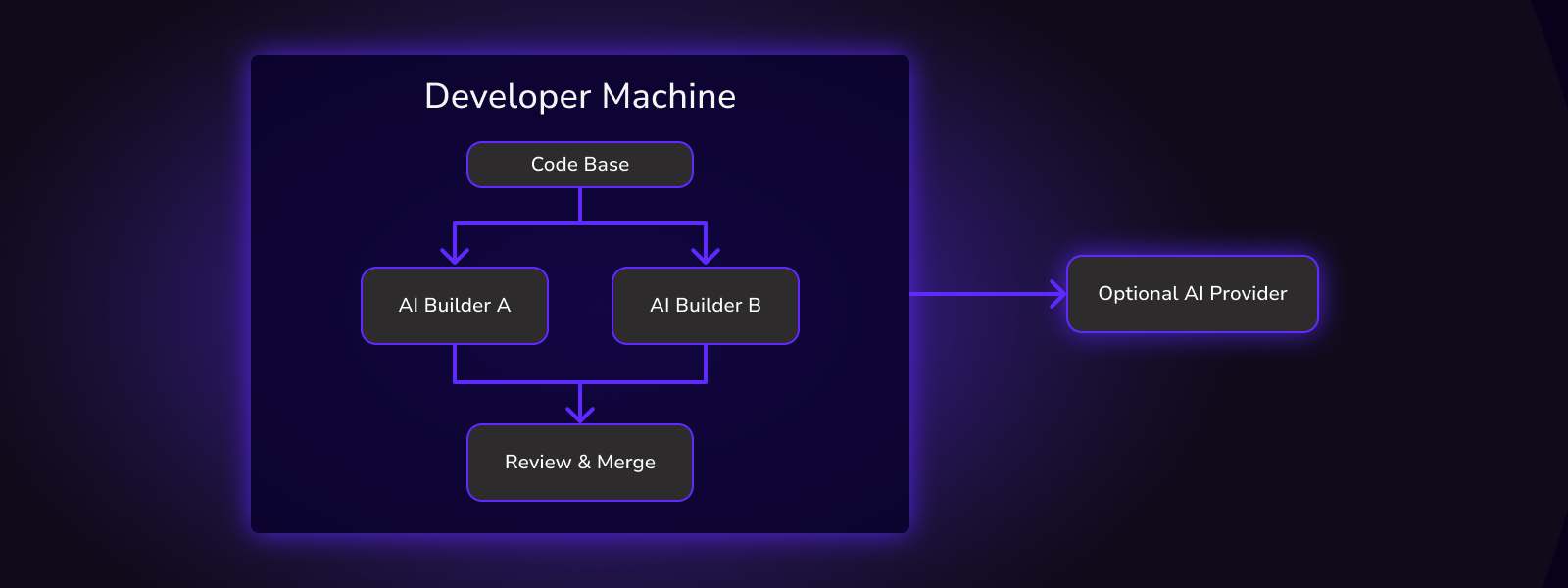
The Ink & Switch research lab defines local-first software as a set of principles that enable both collaboration and ownership for users. The primary copy of data resides on the user's device, ensuring direct control over sensitive information. One critical observation from their research is that cloud architectures store all data from all users in centralized databases, creating attractive targets for attackers. A rogue employee or a hacker who gains access to company servers can read and tamper with everything. Local-first architectures eliminate this single point of failure.
DevSwarm applies these principles to AI-assisted development. Each builder operates in its own Git worktree, maintaining complete isolation from other tasks. The code never leaves your filesystem unless you explicitly push it to a remote repository. AI model connections are configured locally, giving you full visibility into what data flows where.
Security is not just about encryption or compliance checklists. It is about where code runs, how context is isolated, and who controls data flow. Local-first workflows reduce risk by default, not by policy.

The Cloud Security Alliance found that 62% of AI-generated code solutions contain design flaws or known security vulnerabilities, even when developers use the latest foundational models. Veracode's 2025 GenAI Code Security Report showed that 45% of code samples failed security tests and introduced OWASP Top 10 vulnerabilities. These findings underscore the importance of maintaining human review in controlled environments where developers can catch problems before they reach production.
When code stays local, security review happens in your environment with your tools. There is no ambiguity about where sensitive logic resides or who has access to it. The attack surface shrinks because there is no centralized database of customer code waiting to be compromised.
Running locally does not lock teams in. DevSwarm supports cloud-based AI models, local models, and multiple providers simultaneously. The difference is who decides how data flows.
Teams can connect to Claude, GPT, Gemini, or any other cloud-hosted model while keeping their codebase entirely local. The AI receives only the context you choose to send, and responses come back to your local environment. Alternatively, teams running local models through Ollama or similar tools can operate entirely air-gapped, with no external network traffic at all.
This flexibility matters because different organizations have different requirements. A startup building a consumer app may be comfortable with cloud AI providers. A defense contractor or healthcare company may need to ensure that proprietary algorithms never leave their network. DevSwarm accommodates both without forcing architectural compromises.
As AI becomes more capable, trust becomes more important. Developers are increasingly asking not just "can this tool help me?" but "can I verify what it is doing with my code?" Local-first architecture provides answers that cloud-first tools cannot.
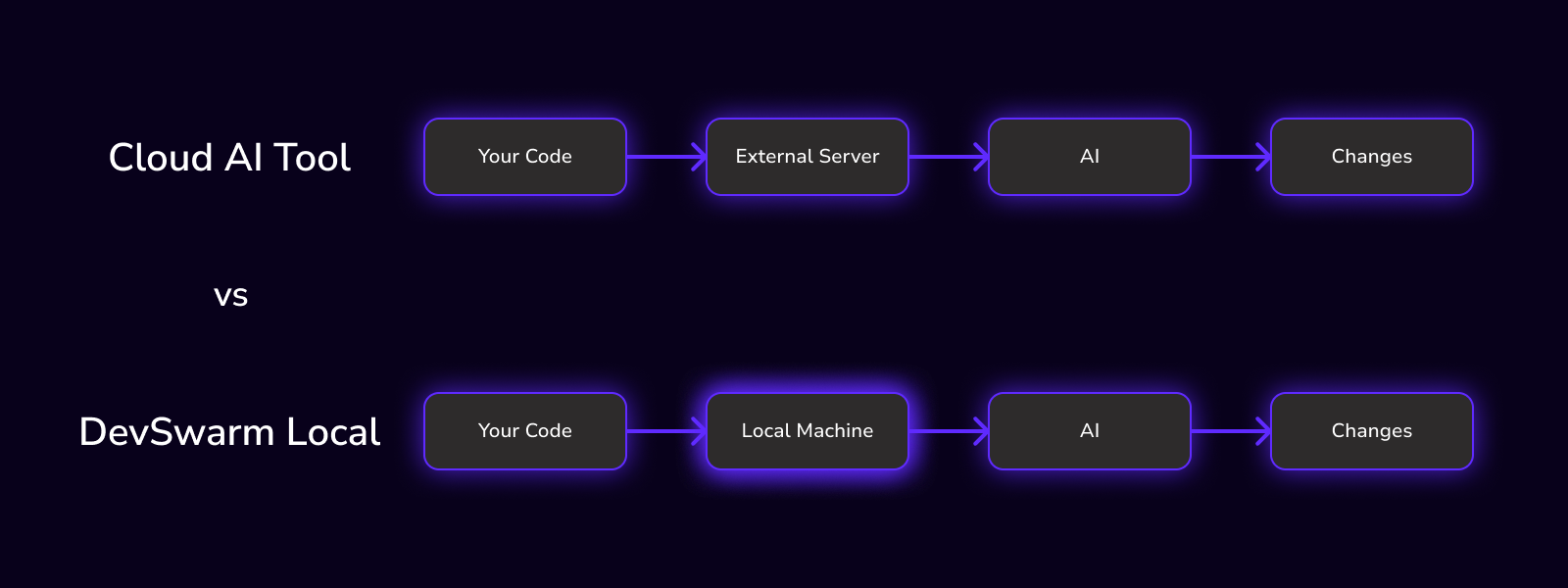
DevSwarm's design ensures that engineers retain ownership of their work, teams understand exactly what ships, and organizations can adopt AI without surrendering control. Every interaction with an AI model is visible. Every file modification happens in an isolated worktree that can be inspected, diffed, and reviewed before merging.
The local-first software movement emerged precisely because cloud architectures, despite their convenience, undermine user agency. DevSwarm applies this philosophy to the specific domain of AI-assisted development, where the stakes are particularly high. Source code represents intellectual property, competitive advantage, and in many cases regulatory liability.
By running locally and isolating work, DevSwarm gives teams the confidence to move fast without handing over their codebase. That is how you get the productivity benefits of AI while maintaining the security posture your organization requires.

